
Composing a Sonata

ELINOR’S BLOG:
This week I worked on composing. I wanted to write a “classic” Minuet that can be followed by variations. I have read Riepel’s chapter with suggestions about what pitfalls to avoid and how to make a Minuet well-composed. However, I usually learn best by making mistakes, so I’ll just dive in and see if I can start and then get feedback from maestro Nick.
First stage is to plan: I will have two sections of 8 bars each.
Opening theme of four bars (tonic and dominant harmonies) followed by a Prinner of 4 bars
Fonte of four bars followed by a cadence of 4 bars
This seems pretty solid!
To get in the zone about Minuets in general, I looked through Giuseppe Clemente Dall’Abaco’s cello sonatas to see what he did, especially for “Minuetto” where he adds variations or suggests the cellist to add them. In his Sonata in F, ABV 17, a set of variations at the end provided a good model. His Fonte at the beginning of the second half doesn’t use ^7-^1 in the bass, so I’m observing alternatives within the standard harmonies. Then I realized that my piece is in Minor and so I have to decide whether I do my Fonte as an all-minor variant, or I stay in the dominant for the Fonte at the second half. Already, I’m mostly thinking from the bass and I am beginning to be weary of how little solfeggio and melody thinking I’m employing in this planning stage.
So I abandon the Fonte and replace it with a Monte. Works fine.
My lesson with maestro Nick revealed that I had missed adding a few solfeggio syllables and therefore the corresponding change in the bass. He also thought my minuet was too simple and short and wanted me to try composing something with more discourse, more elongation, more surprise. We’ll see…
Next composing session I try to make a somewhat faster 4/4 piece in E-flat major. My opening melody is fairly lighthearted so my challenge this time is to have more of a discourse. That means to have more contrast between different themes and also more contrast within a theme. For example, following the rhythm of the solfeggio, something that fragments. Such as “do” for a bar, “re” for a bar, and then “mi, fa, sol” at the half-note level. While this seems simple, it actually takes a lot of skill to maintain well this intrinsic sense of phrasing. Superb phrasing, or “fraseggio puro” begins to operate at a gut level once we sing and play many solfeggi that phrase well.
My lesson with Nick was truly a composition lesson in which solfeggio was our shared language and our guiding tool.
NICK’S BLOG:
There is a difference between minuets for dancing and minuets as subjects for sonata-style discourse. The 8+8 bar model is great as a starting-point, but I know that Elinor can achieve something beyond that. I’ve suggested adding a parenthesis as a contrast or repeating cadences to generate more excitement.
We worked extensively today on singing pure phrases. It is important to build the first skill in solfeggio: acquiring a vocabulary of syllabic schemas with workable metric profiles, which can be adapted for different compositional/improvisational needs. The second skill required in solfeggio - being able to perform of ‘pronounce’ these schemas with expression and variation - belongs to the art of singing/playing. Elinor sang and assimilated over a dozen schemas, and started to apply ornamentation to them. She is rapidly perfecting her composition skills! Which is good, given that she needs to complete three movements by next Wednesday…
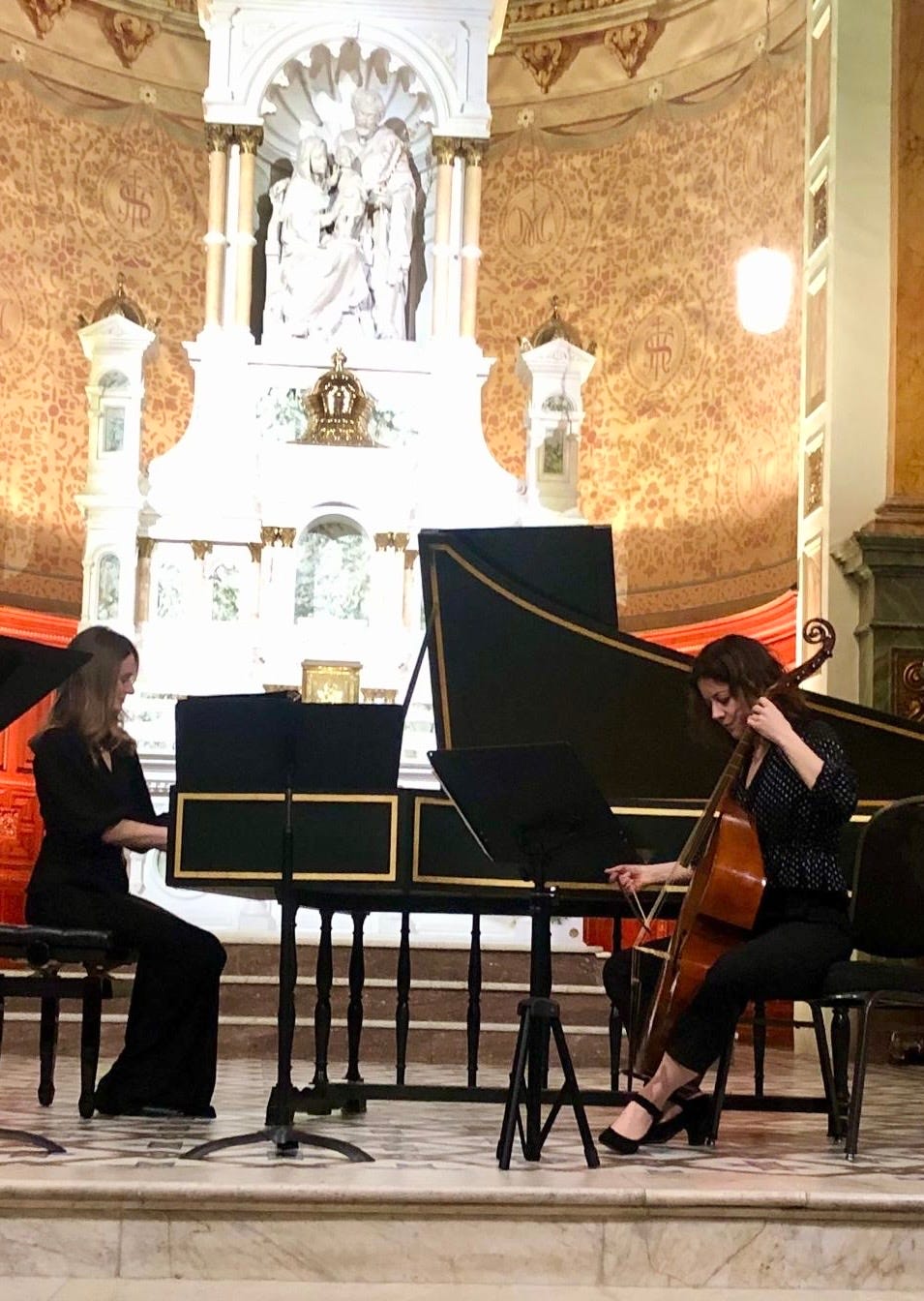
Concert in Quebec City this evening, with Elinor on Viola da Gamba.
Oh my. This all so far over my head.
Fantastic!!