
Learning from Cotumacci

NICK’S BLOG:
Lessons using solfeggi by Carlo Cotumacci
1)
We discussed the manuscript of the Leo concerto and its performance markings. As a fair copy created for amateur performance, it contains lots of markings. These are some of the earliest such markings, hence only f and p. Not to be taken as equivalent to modern terms!
2)
We continued to work our way through Cotumacci’s solfeggi, using No. 31. We practiced adding a bass, which is essential to understand the syllables. The melody is in conversation with the bass, it must respond to it appropriately within the established discourse and topic. We went through some tricks, e.g. the syncopated 171 beneath do re mi or sol fa mi; the art of overlapping phrases so as to smooth over bar lines. In 4/4 time, rhythms such as | 1 2 33 44 | are normally answered not by | 11 22 3 4 | but by 1 [rest] 23344 | 1.
Discussion of ‘form’ as tessitura and condotta. How to lead a thought. Ideas are not original, but their weaving is. Elinor made some suggestions for improvement to my earlier basses, which were gratefully adopted!
For much of October Elinor was busy with concerts across Canada and in Houston, which meant that we had to take a break.
3)
This time we worked through Cotumacci No. 32. We discussed the importance of characterisation, mood and discourse. The theme could be called a ‘Sentence’ but it lacks strict coherence. It starts with a pompous and old fashioned Romanesca which breaks off into (or is silenced by) a vocal fa flourish to high notes, before returning to the staid formal mood through a conventional HC. The playfulness of the discourse then continues with modulatory fragments. It is important that the bass enters into conversation with these twists of the discourse. For instance, the Romanesca calls for a straightforward bass that reflects its formulaic character, rather than something florid and up-to-date or tasteful. The tasteful stuff should kick-off once the flourish interrupts. The cadence too calls for a sober note-for-note style of accompaniment as opposed to, say, an accelerating and energetic run of eighth notes.
We also discussed the syllables. The solmization of the Romanesca is tricky because it features an unusual series of large leaps. We opted to emphasize the fifths of the major and minor triads outlined: do-sol and re-la. The run is obviously a fa-flourish leading to sol la, actually a kind of do-re-mi! The first HC features both mi-fa semitones: the mi on the downbeat is a clear signal for a prepared-suspended accented 4/2 chord.
The modulatory fragments involve a clever inganno treatment of a simple descent to HC: sol fa mi re. The cadence is a Cotumacci classic, do re mi fa -fa mi re do. The inganni in mm.24f offer a classic example of the modulating sol-fa-mi.
Elinor was feeling preoccupied because several musicians were due to arrive in Montreal to practice-research cello partimento with her for the next ten days!
Suggestions for a ‘Rabbit out of a hat’ demonstration: Bach Suite III, Boccherini G major, Haydn concerto, Vivaldi double…
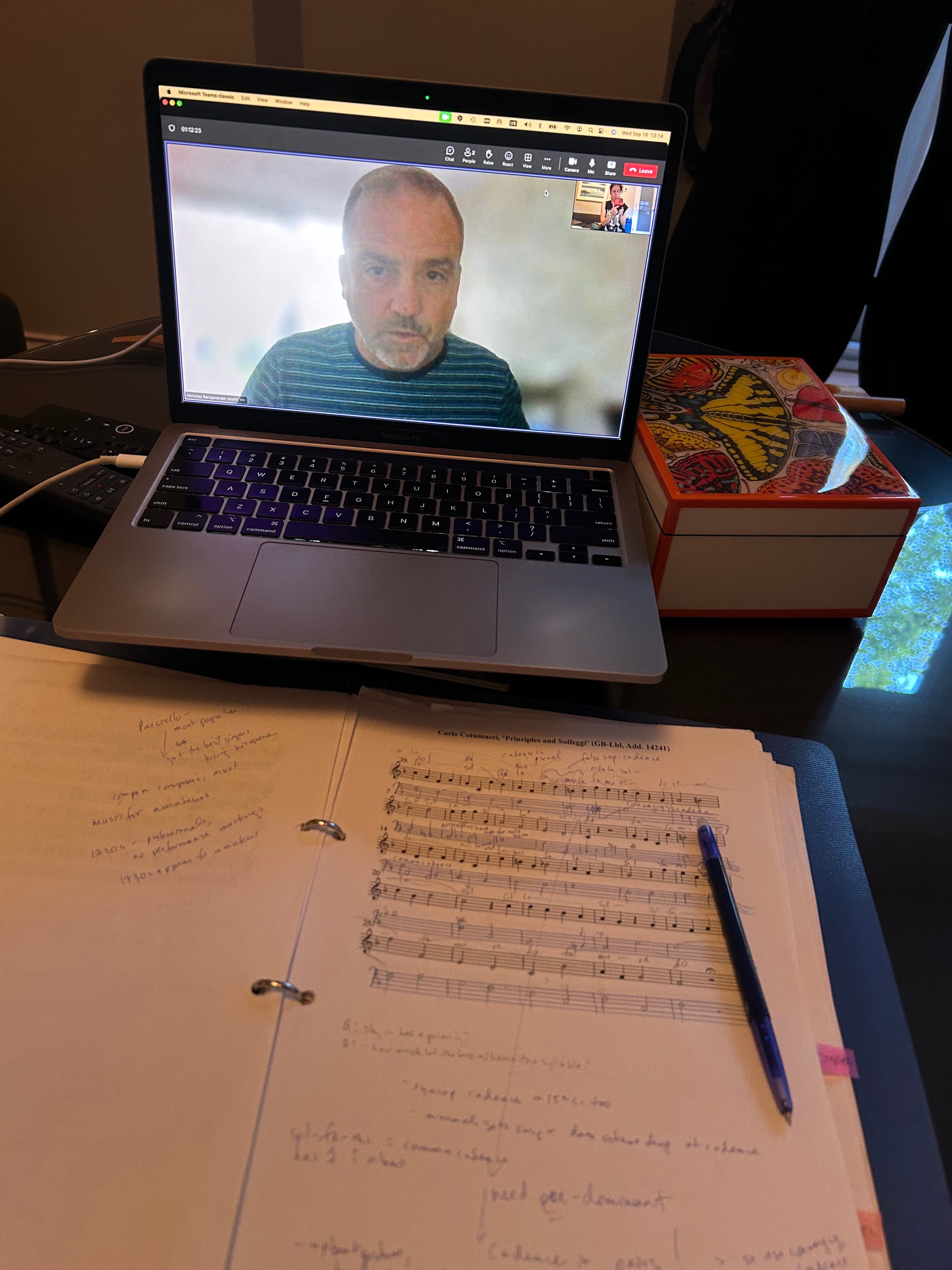
ELINOR’S BLOG:
Here are some of the major skills I’m hoping to learn by studying Cotumacci’s solfeggi.
Solmization
Add a bass
Learn schemata formulas
Practice and explore ornamentation ideas from solfeggio melodies
Variation abilities
Compose my own works
As I go through more and more Cotumacci solfeggi, I both learn new stylistic points and reinforce my understanding of common patterns.
Some examples of the kinds of things we discuss:
“eurithimia” — Nick often points out the rhythmic variety in a Cotumacci solfeggio. For example, if a theme starts of with one main syllable per measure, the next phrase might be more rhythmically complex. Then there might be space, like a rest and then naturally a return to something more serious (a more boring rhythm). This sense of momentum and balance is hugely important in melodic composition.
4/2 chord on the accented beat of a measure. This is often an accented “mi” in the melody and must be prepared.
Harmony in the 18th C. doesn’t conform to Roman Numeral analytical methods. For example, a Fonte can be simultaneously in D and in G. The Tonic and Dominant are overlapping and not in opposition.
When the theme is rhythmically simple, or example, la sol fa over three bars, then the bass needs something contrasting, for example a suspension. If not that, then a syncopation. This helps the bass to avoid sounding heavy.
Since all solfeggios are music, the quality of the composition is first-rate, even if they have pedagogical aims.